Ink & Anarchy
The Underground Comix Revolution of the 1960s and 1970s

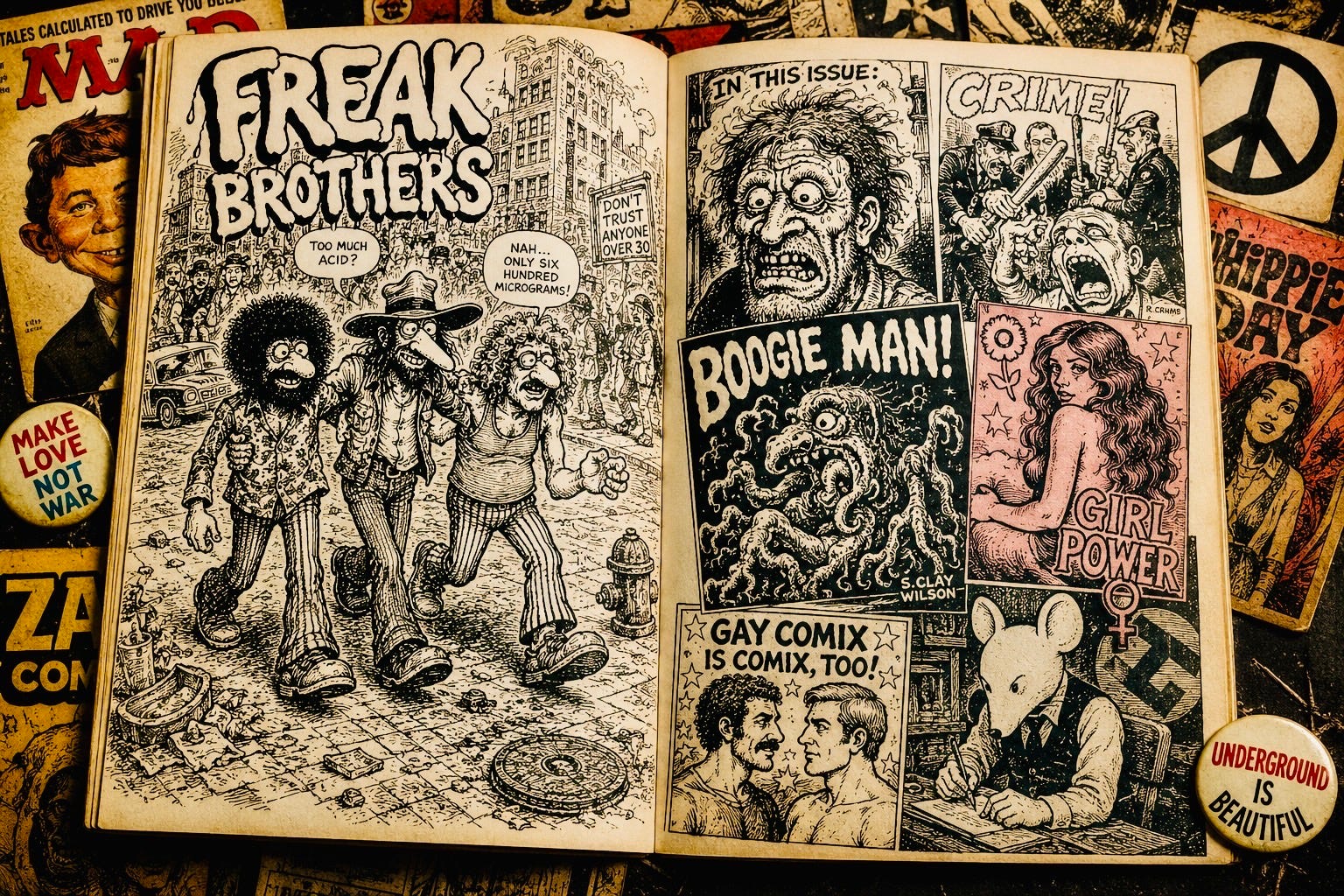
San Francisco, 1968: A young man with round glasses and an anxious disposition pushes a baby carriage through the Haight-Ashbury neighborhood. The carriage contains not an infant, but stacks of a self-published comic book Zap Comix #1.
This image is absurd, defiant, and perfect. It captures everything the underground comix movement was: homemade, confrontational, and smuggled into the world through improvised channels.
Underground comix were not merely a curiosity of counterculture but a genuine revolution in American visual storytelling, one that exploded the boundaries of what comics could say, who could make them, and who they were for.
CHAPTER ONE: Roots and Rebellion: The World That Made Underground Comix Possible
1.1: The Comics Code and the Culture of Censorship
There is a particular kind of cultural energy that only repression can produce. Compress something long enough, deny it air and light and any legitimate channel of release, and it will eventually find its way out, not quietly, but with the force of everything that was held back. To understand why underground comix exploded into American life with such ferocity in the late 1960s, you have to understand what had been sitting on them for the better part of a decade: the Comics Code Authority, one of the most effective acts of institutionalized censorship in American cultural history.
The story begins with a book and a panic. In 1954, a German-born psychiatrist named Fredric Wertham published Seduction of the Innocent, a study that blamed comic books, particularly the crime and horror titles proliferating through newsstands, for the rising tide of juvenile delinquency he claimed to observe in his clinical practice. His methodology was shoddy and his conclusions wildly overreached the evidence, but that was almost beside the point. The book landed in a country already primed for moral panic. The Cold War had convinced Americans that civilization was fragile and that its enemies were everywhere: in communist cells, in Hollywood scripts, in the imaginations of the young. Wertham gave parents and politicians a villain they could hold in their hands and set on fire.
The Senate Subcommittee on Juvenile Delinquency, chaired by Tennessee Senator Estes Kefauver, held hearings in the spring of 1954. Comics publishers were hauled before cameras and asked to justify their products. The message was clear: regulate yourselves or be regulated. By autumn of that year, the Comics Magazine Association of America had established the Comics Code Authority, a self-censoring body whose seal of approval would become the price of admission to most American newsstands. The distributors who controlled access to drugstores and corner shops nationwide simply refused to carry titles without it.
The Code’s prohibitions were sweeping. No depictions of crime presented in a way that inspired sympathy for criminals. No excessive violence, no “walking dead,” no “horror” or “terror” in a title. No illicit sex. No disrespect for established authority — which in practice meant no sustained critique of government, police, or military institutions. The rules were not designed merely to protect children from nightmares; they were designed to protect a particular vision of American life from the corrosive effects of doubt.
The comparison to Hollywood’s Production Code, the Hays Code, which had governed film content since 1934 is instructive. Both operated on the same logic: the cultural form in question (film, comics) reached a mass audience that included impressionable young people, and therefore had to be held to standards that mainstream media and literature were not. The effect in both cases was to turn a potentially powerful medium for social commentary into a machine for the production of reassuring conformity. Under the Hays Code, married couples slept in separate beds. Under the Comics Code, the undead could not be depicted and the word “horror” was banned from cover lines. The anxieties were different; the mechanism was identical.
What the Code actually suppressed, beyond the lurid imagery Wertham had targeted, was social relevance. You could not use comics to argue against the Vietnam War, to depict the reality of drug use without condemning it, to portray sexuality honestly, or to suggest that the American Dream might be a rigged game. EC Comics, whose publisher William Gaines had fought the Code and lost, had run stories about racism, the death penalty, and Cold War paranoia. All of that was now foreclosed. The medium was left with superheroes, talking ducks, and sanitized romance, a nursery version of American life.
The children who grew up in this environment absorbed two lessons simultaneously: the official lesson, which was that comics were harmless fun for kids; and the underground lesson, which was that something real was being kept from them. The teenagers who watched their parents burn their EC horror comics in 1954 would be in their twenties by 1968, with printing presses and something to say. The Code had not killed the energy that produced those comics — it had only delayed it, and compression had made it more volatile.
1.2: Mad Magazine and the Grandfather of Subversion
Before the underground could erupt, it needed a permission slip. It needed someone to demonstrate, in public and with commercial success, that American institutions were ridiculous, that the official story was not to be trusted, and that the appropriate response to authority was not deference but laughter sharp enough to draw blood. That someone was Harvey Kurtzman, and the permission slip was Mad.
Kurtzman launched Mad in 1952 as a comic book under the EC banner, the same publisher whose horror and crime titles would soon be destroyed by the Code. From the beginning, Mad operated differently from anything else on the newsstand. Where other comics offered fantasy and reassurance, Mad offered satire: savage, irreverent, technically brilliant parody of advertising, television, film, politics, and the entire apparatus of postwar American consumer culture. Kurtzman was not simply being irreverent for the sake of it. He was making an argument, that the surfaces of American life were fraudulent, that the smiling faces on the cereal boxes and the confident voices on the television were selling you something, and that the right response was not belief but a raspberry.
The timing was perfect. Mad arrived just as American teenagers were becoming a distinct cultural category with money to spend and an appetite for something that spoke to them honestly. The magazine, it converted to a magazine format in 1955, a move that incidentally placed it outside the jurisdiction of the Comics Code — sold hundreds of thousands of copies. It accumulated a readership that would, within a decade, become the creative generation of the counterculture.
The direct line to underground comix runs specifically through Kurtzman’s post-Madpublication, a humor magazine called Help! that ran from 1960 to 1965. Help! featured a section called “Amateur Hour” that was open to reader submissions, and it was here that several figures who would define the underground comix movement made their first appearances in print. Robert Crumb contributed early fumetti (photo comics). Gilbert Shelton, who would create the Fabulous Furry Freak Brothers, published work there. The network was forming, and Kurtzman was at the center of it, not as a radical, but as a craftsman who had demonstrated that comics could carry intelligence and subversion without necessarily going underground to do so.
This is what Mad offered the next generation: not a model to follow, but a limit to exceed. Kurtzman’s magazine had proven that an audience existed for comics that questioned rather than confirmed, that mocked rather than celebrated. But Mad had its own boundary, a tonal moderation, a commitment to remaining within the range of what newsstands and advertisers would tolerate. It could satirize a television commercial, but it would not show you a drug trip from the inside. It could mock a politician, but it would not print a manifesto. It tested the edges but never broke through them.
The underground comix artists knew exactly where that line was, because they had grown up reading the magazine that had drawn it. And they knew, with the certainty of people who had been waiting a long time, that the entire point was to step over it. Madhad taught them that satire was a weapon. They intended to use it without the safety catch.
1.3: Haight-Ashbury and the Countercultural Ecosystem
A revolution needs more than grievance and vision. It needs geography, a physical place where the necessary conditions concentrate, where the right people find one another, where the infrastructure for dissemination takes shape before anyone has thought to regulate it. For underground comix, that place was San Francisco’s Haight-Ashbury neighborhood in the years between 1965 and 1970, and understanding what made it work as an ecosystem is as important as understanding any individual artist or publication.
By 1967, Haight-Ashbury was the most-discussed neighborhood in America. The convergence of the antiwar movement, the psychedelic drug culture, the free love philosophy, and the folk and rock music scenes had turned a Victorian residential neighborhood into the capital of a counterculture that felt, to its participants and its observers alike, like the beginning of something genuinely new. The density was remarkable: in a few square miles, you had musicians recording albums that would sell millions, poets running mimeograph presses out of apartments, activists organizing against the war, and artists doing work that had no existing category.
Among those artists were the people who would make underground comix. Robert Crumb had arrived from Cleveland, drawn by the same gravitational pull that was drawing young people from across the country. Gilbert Shelton came from Texas. Rick Griffin, whose psychedelic poster work for the Grateful Dead had already made him visually famous, was there. Victor Moscoso, trained at Yale and the San Francisco Art Institute, brought a formal sophistication to psychedelic design that would influence the aesthetic language of the entire movement. They were not an organization; they were a neighborhood, which is sometimes a more generative thing.
What made the Haight function as an incubator rather than just a gathering was infrastructure, specifically, two kinds of infrastructure that bypassed the systems that had enforced the Comics Code. The first was the underground press. Publications like the San Francisco Oracle, the Berkeley Barb, and the East Village Other in New York were printing radical politics, drug journalism, and art that no mainstream publisher would touch. They also printed comics, which meant that cartoonists had a ready venue that was already reaching the audience they wanted to reach. The Underground Press Syndicate, a loose federation of alternative papers, meant that a strip that appeared in San Francisco this week might be reprinted in a dozen cities next week, with no distributor approval required.
The second piece of infrastructure was the head shop. These were retail stores, selling rolling papers, psychedelic posters, incense, and the general merchandise of the drug culture — that also sold underground publications. They were the underground comix distribution network, and they were perfect for the purpose: ideologically aligned with the material they sold, geographically dispersed across every city with a counterculture presence, and entirely outside the newsstand distribution system that enforced the Comics Code. You did not need the approval of a national distributor to get your comic into a head shop. You needed a car, a box of printed copies, and the willingness to drive around selling them on consignment.
When Robert Crumb pushed that baby carriage down Haight Street in 1968, selling Zap Comix #1directly to passersby, he was not just performing an eccentric act of self-promotion. He was demonstrating the essential logic of the entire movement: that the official channels could be circumvented, that the audience was right there in the street, and that all you needed was the nerve to print what you actually wanted to say and hand it to the people who wanted to read it. The neighborhood had provided everything else.
The smell of that world, incense and newsprint and the chemical sweetness of cheap ink, is inseparable from the work it produced. These were not artists working in isolation toward some abstract ideal of creative freedom. They were people embedded in a community that was, in its chaotic and often contradictory way, trying to build something new. The comix they made were not documents of that attempt — they were part of it, and they carried its energy, its recklessness, its brilliance, and its failures in every line.
CHAPTER TWO: The Pioneers: Visionaries Who Defined the Form
2.1: Robert Crumb: The Tortured Genius at the Center
Every movement has a figure who seems, in retrospect, both inevitable and impossible — someone whose particular obsessions happened to align with a historical moment so precisely that they became the lens through which the moment understood itself. For underground comix, that figure was Robert Crumb: a socially catastrophic, neurotic, furiously talented artist from Cincinnati who arrived in San Francisco in 1967 with a suitcase, a sketchbook, and a private universe already fully formed and straining to get out.
The first issue of Zap Comix, self-published in early 1968 and sold from a baby carriage on Haight Street, is the conventional starting gun of the movement, but the story of what Crumb put into it matters as much as the act of publication. His style was unlike anything else in American comics: dense cross-hatching that gave figures a trembling, anxious energy; bodies distorted with a grotesque anatomical logic all their own; faces capable of expressing states of interior wretchedness that the medium had previously had no vocabulary for. He had absorbed 1930s newspaper cartooning, Bud Fisher, E.C. Segar, and filtered it through the particular acid bath of his own psychology. The result was a line that felt, simultaneously, like a throwback and like nothing that had ever existed.
His characters became the iconography of a generation. Mr. Natural, the fraudulent guru dispensing cryptic wisdom with serene unconcern. Fritz the Cat, the collegiate poseur whose appetites overrode every principle he professed. Keep On Truckin’ figures, striding forward with manic momentum into no particular destination. These images escaped their original context entirely, appearing on posters, T-shirts, van murals, in the visual vernacular of counterculture communities from Haight-Ashbury to Amsterdam. Crumb had not set out to design a movement’s aesthetic; he had simply drawn what was in his head, and what was in his head turned out to be what an enormous number of people recognized as their own.
But the work cannot be discussed without confronting what else was in his head. Crumb’s strips were populated with racist caricatures drawn in the exaggerated tradition of minstrel imagery. His female characters were overwhelmingly objects of a specifically degrading fantasy, large-bodied, sexually available, frequently subjected to violence that was played for comedy or arousal or both. These were not incidental elements, not lapses in an otherwise progressive body of work. They were central, recurring, and apparently deliberate. Crumb himself has never satisfactorily resolved the question of what they mean has oscillated between claiming them as honest self-portraiture (these are my actual obsessions, laid bare) and acknowledging their capacity to cause harm. Neither answer quite covers it.
What makes the contradiction productive rather than merely disqualifying is that it mirrors, in an unusually concentrated form, the contradiction at the heart of the whole underground project. The movement defined itself as liberation: from censorship, from conformity, from the sanitized official version of American life. But liberation from external constraint does not automatically produce justice. It can just as easily produce a more uninhibited version of whatever the artist already believed, which in a culture built on racism and misogyny means more racism and misogyny, delivered with greater honesty and force. Crumb’s work did not invent this problem. It simply made it impossible to look away from.
What it also made impossible to look away from was a new mode of comics-making: the confessional. Crumb did not tell stories about heroes, about fantasy, about the world-as-it-should-be. He told stories about himself: his fears, his shames, his desires, his sense of fraudulence and irrelevance, his relationship to his own body and mind. Comics as therapy, as self-examination, as a record of the psyche rather than an escape from it. This was genuinely new, and its influence on everything that followed: from Art Spiegelman’s Maus to Alison Bechdel’s Fun Home to Chris Ware’s Jimmy Corrigan is direct and acknowledged. The template Crumb established was not just a visual style. It was a permission to use the form to tell the truth about interior life, without redemption arcs, without the consolations of narrative resolution. Just the sketchbook, the obsessive line, and the unflinching witness.
2.2: Gilbert Shelton, Spain Rodriguez, and the Political Underground
Not everyone who came to underground comix came through the looking glass of private neurosis. Some came through the barricades. While Crumb’s work was characteristically turned inward, mapping the psyche’s humiliations with relentless, almost masochistic precision, another wing of the underground looked outward, using the freed space of comix to make arguments about a country they considered badly broken. Chief among these were Gilbert Shelton and Spain Rodriguez, two artists whose work could not have been more different in tone but who shared a conviction that the comic strip was a legitimate vehicle for political thought.
Shelton arrived in the underground from Texas, where he had been drawing cartoons for the University of Texas humor magazine The Texas Ranger since the early 1960s. His sensibility was comic rather than apocalyptic. a satirist’s instinct for the gap between what people claim to believe and how they actually behave. The Fabulous Furry Freak Brothers, first published in an Austin underground newspaper in 1968 and later collected and distributed nationally through Rip Off Press, followed three stoner antiheroes: Phineas, Fat Freddy, and Freewheelin’ Franklin through a series of misadventures driven almost entirely by their need to acquire, protect, and consume marijuana. The strips were brilliantly plotted comic machines, each one built around an escalating series of complications that Shelton resolved with the timing of a practiced vaudevillian.
But the comedy had a target. The Freak Brothers existed in perpetual war with straight society, with landlords, police, courts, employers, and the entire apparatus of bourgeois normality that regarded their lifestyle as criminal. The famous motto “Dope will get you through times of no money better than money will get you through times of no dope” was not merely a joke about drug culture. It was a philosophical position: that the values of the counterculture (pleasure, communal loyalty, the rejection of productivity as a moral category) were superior to those of the society that condemned them. Shelton made this argument through laughter, which meant it could reach people who might have walked away from a manifesto. The strips were reprinted across dozens of underground papers via the Underground Press Syndicate, becoming movement literature distributed with the velocity of rumor.
Where Shelton deployed absurdity, Spain Rodriguez brought fury. Rodriguez had grown up in Buffalo, where he ran with a motorcycle club called the Road Vultures before moving to New York and becoming a cartoonist for the East Village Other. His visual style was hard-edged and dense, influenced by EC horror comics but forged into something more directly political, figures rendered with the compressed energy of people who might, at any moment, lunge off the page. His signature creation was Trashman, a revolutionary street fighter operating in a near-future America controlled by a fascist corporate state. Trashman did not negotiate or satirize. He fought — against police, against corporate soldiers, against the machinery of oppression, with a directness that left no interpretive ambiguity about where Rodriguez’s sympathies lay.
Rodriguez had been shaped by actual political organizing in ways that most underground comix artists had not. His biker background gave him a working-class perspective that was somewhat distinct from the largely middle-class college counterculture that populated Haight-Ashbury. Trashman was not hippie liberation fantasy, it was closer to Third World revolutionary literature, translated into the visual language of American genre comics. The strips circulated in the underground press as genuine agitprop, read by activists who saw in Trashman a fantasy of direct action against a state they considered illegitimate.
The question of whether any of this constituted political art in the serious sense, or whether the politics were primarily an alibi for drawing transgressive content without apology, is worth sitting with rather than dismissing. Shelton’s strips are too well-constructed, too genuinely funny, too precise in their satire, to be explained as mere pretext. Rodriguez’s work carries an anger too specific and too consistently directed to be decorative. But it is also true that the freedom to be political and the freedom to be explicit were not cleanly separable in the underground comix world, they arrived together, in the same publications, under the same ideological banner of liberation from censorship. The tension between genuine political commitment and the pleasure of transgression for its own sake runs through the work of both artists, and through the movement as a whole. That tension was not a flaw. It was, in many ways, the engine.
2.3: S. Clay Wilson and the Aesthetics of Transgression
If Robert Crumb represents the underground comix movement’s confessional mode and Gilbert Shelton and Spain Rodriguez represent its political wing, then S. Clay Wilson represents something harder to categorize and considerably more difficult to defend: the movement’s commitment to absolute, unqualified freedom of expression, pursued so relentlessly and with such apparent delight in its own extremity that it forces a reckoning with what freedom of expression actually means when it is taken seriously as a principle rather than as a slogan.
Wilson appeared in Zap Comix beginning with the second issue, in 1968. Crumb had conceived Zap as his own publication, but Wilson crashed the party, reportedly showing up with finished pages and an attitude that suggested rejection was not a realistic option. Crumb, to his lasting credit, included them. What Wilson brought to Zap was a visual world unlike anything else in the underground: baroque, cluttered, almost overwhelming in its density of incident, populated by demonic biker gangs, marauding pirates, occult figures, and an assortment of human and semi-human creatures engaged in acts of violence and sexuality so extreme that they seemed designed less to shock the reader than to test the structural limits of the comic panel itself.
Wilson’s visual style had a paradoxical quality: it was, by any formal measure, accomplished. His pages were architecturally complex, managing dozens of figures in states of simultaneous action without losing compositional coherence. The line was confident and detailed. The grotesque anatomy was consistent, almost systematic, not the distortion of incompetence but the distortion of a highly specific vision pursued with great technical skill. He was, in the most uncomfortable sense, a good artist. What he chose to do with that skill was another matter.
His strips had no redemptive arc, no satirical target, no confessional vulnerability, no political argument. They existed, as nearly as one can tell, to push the representation of human brutality and sexuality as far as the page would allow, and to do so with a kind of gleeful operational indifference to the suffering depicted. Where Crumb’s most disturbing imagery was mediated by obvious psychological complexity, you could trace the damage, feel the self-implication, Wilson’s offered no such handholds. The violence was not commented upon. It simply occurred, lavishly, in panels that were easy to admire as formal constructions and impossible to read without a growing sense of unease about what, exactly, one was looking at.
The critical debate about Wilson’s work has never reached consensus, and the honesty of this essay requires acknowledging that it will not resolve the question either. Defenders situate him in a long tradition of grotesque art, the carnival freaks of Bruegel, the damnation scenes of Bosch, the Rabelaisian tradition of transgression as critique of civilization’s pretensions to order and dignity. On this reading, Wilson’s chaos is a mirror held up to a society that conducts its own violence at a more respectable remove. Critics counter that this reading is too generous, that it uses the framework of art history to launder work whose primary effect is the dehumanization of women and the aestheticization of cruelty, and that the tradition of transgressive art does not automatically validate any particular transgression.
What can be said with more confidence is what Wilson’s presence in the movement reveals about the movement’s founding commitments. The underground comix world, at its core, held that censorship was the enemy, that the freedom to express whatever was in the artist’s mind, without institutional gatekeeping, was an absolute good. Wilson was the most rigorous test of that principle. If the movement meant what it said about freedom, it had to find room for Wilson. And it did. Crumb later acknowledged that Wilson’s arrival on the Zap roster pushed him to go further in his own work, that the competition, if it can be called that, moved the whole endeavor toward greater extremity.
What no one in the movement fully grappled with, and what this essay will take up directly, is the question of who pays the cost of absolute artistic freedom when the things being freely expressed are fantasies of domination over people who are already dominated. The underground declared war on censorship. What it did not adequately reckon with was the difference between the censorship that serves power and the harm that freedom, exercised without accountability, can produce. Wilson’s work is where that unresolved question lives most uncomfortably. It has not gone away.
CHAPTER THREE: Margins Within the Margins: Women, Identity, and the Limits of Liberation
3.1: It Ain’t Me Babe and the Birth of Feminist Comix
Every liberation movement eventually arrives at the same uncomfortable discovery: that the people doing the liberating have not liberated themselves from all of their assumptions. The underground comix world reached this discovery around 1970, and the vehicle of that discovery was a woman from New York named Trina Robbins, who had been watching the scene from the inside long enough to understand exactly what it was and was not doing.
Robbins had come to San Francisco as part of the same countercultural migration that brought Crumb and Shelton. She could draw, her line was clean and decorative, influenced by fashion illustration and early twentieth-century women’s comics in a way that was immediately distinct from the cross-hatched male aesthetic that dominated Zap and its imitators. She had contributed to underground papers, designed clothes, moved in the circles where the movement was being made. She was, in every meaningful sense, an insider. Which meant she had an insider’s view of what the rhetoric of liberation looked like when you were the person being liberated from.
The male underground comix world was, in practice, a closed shop. Women were its subject matter, its bodies, its fantasies, its objects of desire and violence and ridicule, far more consistently than they were its creators. The masthead of Zap Comixwas exclusively male. The editorial gatekeeping of most underground titles was male. At conventions and gatherings, women who tried to show their work were routinely dismissed or ignored. The transgressive energy that was supposed to blow apart every social convention had somehow left intact the convention that comics were made by men. The freedom to be explicitly sexual had been deployed almost entirely as the freedom of men to be explicitly sexual about women, with no reciprocal consideration of whether women might have their own sexuality worth depicting, or their own stories worth telling, or their own relationship to their bodies that did not begin and end with what men wanted from them.
It Ain’t Me Babe, published in 1970 by Last Gasp and organized by Robbins, was the answer to all of this. It was the first all-women comics anthology in American history, a single issue that collected work by Robbins and a group of Bay Area women artists including Michele Brand, Willy Mendes, and others. The title was borrowed from a Bob Dylan song, a song about a man telling a woman she’s asking too much of him, and its reappropriation as the title of a feminist comics anthology was a precise act of cultural criticism. The liberation the men were offering was not, the title announced, the liberation women needed. That was something they would have to build themselves.
The content of It Ain’t Me Babe went directly at the territories the male underground had colonized and distorted. Female sexuality was depicted from the inside rather than the outside, as experience rather than spectacle. The strips addressed friendship between women as a subject worthy of narrative attention in its own right, not as backdrop for male adventure. The anthology’s visual language was deliberately different from the underground mainstream: lighter, more ornamental in places, drawing on traditions of women’s illustration that the male underground had implicitly coded as insufficiently serious. This too was an argument. The aesthetic choices were not accidental. Robbins and her collaborators were insisting that their visual inheritance was as legitimate as Crumb’s, that the 1930s cartooning Crumb worshipped was not the only valid source of formal influence.
What Robbins did that was as important as making the anthology was making the infrastructure to support it. She organized. She identified other women working in isolation, brought them into contact with one another, pushed the work toward publication, and negotiated the distribution. This is unglamorous labor that tends to disappear from cultural histories in favor of the lone genius narrative, the baby carriage on Haight Street, the solitary vision made manifest. But movements are not made by lone geniuses alone. They are made by organizers who build the structures within which multiple visions can exist and circulate. Robbins understood this, and she built accordingly. The feminist comix movement that followed It Ain’t Me Babe was not a single voice but an ecosystem, and she had done as much as anyone to plant it.
3.2: Wimmen’s Comix and Two Decades of Radical Collaboration
The institution that grew most directly from the ground It Ain’t Me Babe had broken was Wimmen’s Comix, launched in 1972 and published with remarkable consistency for the next two decades. Where It Ain’t Me Babe had been a single issue, a declaration, Wimmen’s Comix was an ongoing project, a commitment, and in its organizational structure, an argument made again and again across twenty years about how a creative community should govern itself.
Most underground comix titles were expressions of a single sensibility. Zap was Crumb’s world, into which other artists were admitted on terms he largely controlled. The Fabulous Furry Freak Brothers was Shelton’s strip, his voice, his jokes. Even the more open anthologies tended to have a dominant editorial personality. Wimmen’s Comix was structured differently from the start: it was run by a rotating collective, with editorial control passing between contributors rather than residing in any permanent editor or publisher. No single woman’s vision would dominate. No hierarchy of established names would determine whose work was worthy. The collective would decide together, issue by issue, who contributed and what got printed.
This was not simply a pragmatic administrative choice. It was a structural argument about creative authority and its relationship to power. The lone genius model — which the underground had inherited from mainstream art culture and, for all its radicalism, never fundamentally questioned, assumed that the individual artist of sufficient talent and vision should operate with maximum autonomy. The collective model assumed something different: that creative communities produce better, more varied, more honest work when authority is shared and when the editorial gaze is not a single perspective but many. The argument was, in this sense, simultaneously aesthetic and political. How you organize a magazine is a statement about how you believe a community should work.
The contributors to Wimmen’s Comix over its twenty-year run formed a roster of remarkable range. Trina Robbins was there from the beginning. Aline Kominsky-Crumb, whose raw autobiographical strips made her one of the most formally adventurous cartoonists of the period, contributed extensively. Lee Marrs brought a more comedic sensibility. Melinda Gebbie, who would later collaborate with Alan Moore on the graphic novel Lost Girls, developed her lush, heavily decorated style in its pages. Sharon Rudahl produced politically engaged work that connected feminist concerns to labor history and leftist politics. The anthology gave each of these artists a venue, a readership, and — perhaps most importantly — a community of peers at a time when women working in comics had no other institutional home.
The evolution of the publication across its run is itself a kind of history. Early issues had the rawness of necessity — work produced quickly, under constraints of time and resources, with the urgency of a publication that needed to exist before it could afford to be polished. The topics were often explicitly polemical: abortion, rape, the failures of the sexual revolution as experienced by women rather than described by men, the specific textures of domestic labor and economic precarity that the male underground treated as invisible. As the years passed and the contributors developed their craft, the range expanded. Science fiction, fantasy, humor, personal memoir, historical narrative — Wimmen’s Comix became a genuinely capacious publication, one that could hold Kominsky-Crumb’s anxious autobiography in the same issue as Rudahl’s historical reportage or Gebbie’s decorative dreamwork.
The legacy runs forward in ways that are easy to trace. Many of the women who developed their work in Wimmen’s Comix went on to shape the alternative comics movement of the 1980s and 1990s — the movement organized around publishers like Fantagraphics and Drawn & Quarterly that would finally, definitively, establish comics as a serious artistic medium in America. The underground had built an infrastructure; Wimmen’s Comix had used it to develop a generation of artists who were ready, when the culture caught up, to be recognized.
What is worth acknowledging alongside this achievement is that the collective model was not without its own difficulties. Collectives make decisions slowly and often painfully; they are vulnerable to the same interpersonal dynamics they are designed to prevent; their commitment to inclusion can produce genuine conflict when contributors disagree about what inclusion requires. Wimmen’s Comix had its tensions, about race, about sexuality, about who belonged in the category of “women” the publication claimed to represent, about whether lesbian identity would be centered or marginalized within a feminist publication that some contributors saw as primarily heterosexual in its concerns. These tensions were not resolved, exactly. They were worked through, issue by issue, in the way that living institutions work through things, imperfectly, sometimes painfully, with results that are neither complete victories nor complete failures. That, too, is part of the record.
3.3: Gay Comix and the Visibility Underground
The underground comix movement had been built, at least in part, on sexual transgression. It had depicted homosexuality, in the work of S. Clay Wilson and others, with frequency and without the coded discretion of mainstream culture. What it had not done was depict gay and lesbian identity as something that belonged to real people, with interior lives worth inhabiting, communities worth representing, and experiences that deserved to be told on their own terms rather than deployed as another instrument of shock. The difference between representation and exploitation is not always easy to draw, but in the underground comix world it was, for most of the 1970s, not difficult to identify. Gay and queer people appeared in the movement’s publications. They were not, in any serious sense, of them.
The founding irony here is sharp enough to require naming directly. The men who made underground comix had been sexually liberated by the movement’s rejection of the Comics Code, free to depict desire and fantasy in the full breadth of their imaginations. That freedom was exercised almost entirely within the conventions of heterosexual male fantasy, which meant that homosexuality appeared primarily as spectacle, perversion, or punchline, as something to be observed from the outside and found, depending on the strip, transgressive or absurd or threatening, but never simply human. The underground had blown through censorship’s walls without noticing that it had rebuilt some of them in different locations.
The response, when it came, followed the logic the movement had itself established. If the principle was that any community could pick up a press and publish its own truth, that the distributed infrastructure of underground publishing existed precisely to route around the gatekeepers who decided whose experiences were legitimate, then gay and lesbian artists were simply claiming what the underground had already proven possible. The tools were there. The model was there. What was needed was people willing to use them for this particular purpose.
Mary Wings had begun that work as early as 1973, self-publishing Come Out Comix, a small comic about lesbian identity that circulated through feminist and gay community networks. Wings drew in a clean, accessible style and told stories about the experience of being a young woman discovering her sexuality in a world that did not have space for it, stories that were entirely unremarkable in their emotional content and entirely radical in their refusal to treat that content as anything but ordinary. The normality was the point. In a culture where gay identity was legible primarily as deviance, a comic that simply showed a lesbian character living her life, falling in love, navigating her world, was a political act dressed in the clothes of the everyday.
Gay Comix, launched in 1980 by Howard Cruse, was the first ongoing anthology to pursue this project systematically. Cruse was a cartoonist who had been working in the underground for several years, with a warm, expressive line and a gift for character. His vision for Gay Comix was straightforward: an anthology that would do for gay and lesbian readers what Wimmen’s Comix had done for women, provide a venue, build a community, and demonstrate that the experiences being depicted were worth the attention of serious artistic effort. The first issue collected work by Cruse alongside contributions from other gay and lesbian cartoonists who had been working without a publication to call their own.
What the publication could not have fully anticipated was the historical context it was about to enter. Gay Comix launched in 1980, and by 1981 the AIDS crisis had begun to reshape every dimension of gay life in America. The publication’s project of visibility, already politically urgent in a culture that considered homosexuality either pathological or invisible, became something more acute: a form of witness in the face of catastrophic loss. Issues of Gay Comixfrom the mid-1980s onward are historical documents of a community under siege, recording experiences that the mainstream press was slow to cover and that official culture preferred not to acknowledge. The strips depicted illness and grief and fear and the particular texture of watching a community disintegrate while the institutions that might have helped looked away. They also depicted joy, desire, humor, and the stubborn refusal of ordinary life to stop occurring even in the midst of catastrophe. The full range of human experience, in other words, which is all that any serious publication ever asks of itself.
Cruse’s own career after Gay Comix demonstrates how the underground infrastructure could enable sustained artistic work across decades. Stuck Rubber Baby, the graphic novel he published in 1995, drew on his experience coming of age in the American South in the early 1960s to tell a story about the civil rights movement, sexual identity, and the relationship between personal and political liberation. It is a work of significant ambition and real accomplishment, made possible by a career built on the foundation of underground self-publishing. The baby carriage logic, that you could make something real without waiting for institutional permission, had held, even as the world it was navigating had changed almost beyond recognition from the one in which Crumb had pushed his copies of Zap down Haight Street.
The arc from It Ain’t Me Babe through Wimmen’s Comix to Gay Comix and its inheritors is not, in the end, a story of the underground comix movement gracefully expanding to include everyone it had initially excluded. It is a story of people who took the movement at its word, who accepted its stated principle that freedom of expression belonged to everyone, and who had to fight, organize, and build their own parallel structures to make that principle real. The movement had given them the tools and the model. What it had not given them was welcome. They took the tools anyway.
CHAPTER FOUR: Legacy and Long Shadow: How Underground Comix Remade the Medium
4.1 From Underground to Alternative: Art Spiegelman, Raw, and the Bridge to Graphic Novels
Movements do not end cleanly. They dissolve, mutate, send tendrils into adjacent territories, get absorbed by the cultures they were rebelling against, and leave behind a generation of artists who carry what was learned into forms that are recognizable as descendants even when they have shed the original’s most distinctive markings. The underground comix movement peaked commercially somewhere around 1973 and began its decline shortly after, squeezed by the closing of head shops, the legal harassment of distributors, and the gradual dispersal of the Haight-Ashbury community that had given it its geographic center. But the energy it had released did not dissipate. It went somewhere, and the most consequential place it went was into the hands of Art Spiegelman, who would use the tools and freedoms the underground had built to make the argument that comics were a serious literary medium in a way that could not be dismissed.
Spiegelman had come up through underground comix in the way that many artists of his generation had, contributing to anthologies, absorbing the ethos of self-publication and creative autonomy, developing a visual style that drew on the underground’s formal experiments while reaching toward something more formally rigorous. He had co-edited Arcade with Bill Griffith in 1975, an anthology that had functioned as a kind of valediction for the first wave of underground comix, collecting the movement’s major voices at the moment the movement itself was contracting. What Spiegelman brought to this inheritance was a quality the underground had not always prized: deliberateness. He was a thinker as well as a cartoonist, someone who theorized the medium even as he practiced it, and who was unwilling to accept that the freedom the underground had won could only be used in the ways the underground had used it.
In 1980, Spiegelman and his partner Françoise Mouly launched Raw, a large-format anthology magazine that became the bridge between underground comix and what would eventually be called alternative or literary comics. Raw was self-consciously post-underground, more connected to the European avant-garde tradition, more interested in formal experiment for its own sake, more comfortable in galleries and art schools than in head shops. It published work by European cartoonists like Jacques Tardi and Joost Swarte alongside American artists who had emerged from or been influenced by the underground, and the combination produced a publication that felt genuinely international and genuinely serious in a way the underground had rarely aspired to be. The head shop was not the destination. The museum, the bookstore, the literary review, these were the territories Raw was staking out.
Running through the pages of Raw, issue by issue from 1980 onward, was a serialized work that would eventually reframe the entire cultural conversation about what comics could do. Maus, Spiegelman’s account of his father Vladek’s survival of the Holocaust and his own fraught attempts to record and understand that history, told its story through an extended visual metaphor: Jews as mice, Nazis as cats, Poles as pigs, Americans as dogs. The device was simple and devastating, forcing the reader to hold simultaneously the abstraction of the allegory and the unbearable specificity of what the allegory contained. It was also, unmistakably, a work in the confessional mode that Robert Crumb had pioneered a decade earlier, a son using the comic form to excavate his own psychological complexity alongside the historical material, refusing the consolations of heroic narrative, keeping the author visibly inside the frame.
The debt to Justin Green’s Binky Brown Meets the Holy Virgin Mary, the 1972 underground comic in which Green had first deployed the autobiographical mode with full psychoanalytic intensity, is one that Spiegelman has acknowledged explicitly. Binky Brown had demonstrated that the comic form could sustain a sustained first-person investigation of the self without ironic distance or the reassurances of plot resolution. Maus took that discovery and applied it to the largest subject imaginable. When Pantheon collected the first volume in 1986 and the second in 1991, and when the complete work received the Pulitzer Prize in 1992, the first comic ever to do so, and still the only one, it was not just a personal triumph. It was the underground’s argument, made at last in language that the literary establishment could not ignore.
The paradox is worth sitting with: the movement achieved mainstream legitimacy by moving away from what had made it radical. Maus is not a transgressive work in the underground sense. It does not revel in freedom from the Comics Code; it does not celebrate drug use or depict sexuality; it is not distributed through head shops or produced outside existing publishing institutions. It is a serious literary work published by a mainstream press and reviewed in publications that had spent decades refusing to take comics seriously. The underground had blown down the wall. What walked through it was something more decorous than the movement that had done the blowing. This is not a criticism. It is simply the way influence works, and the way movements survive their own endings.
4.2 Creator Rights and the Independent Comics Revolution
There is a dimension of the underground comix movement’s legacy that receives less attention than its aesthetic innovations but may, in the long run, have reshaped the comics industry more profoundly: the economic model. Underground comix artists owned their work. This was not a philosophical position arrived at through debate, though it became one. It was an operational necessity, when you self-publish, you retain the copyright because there is no publisher to sign it over to. But the necessity became a principle, and the principle, once articulated and demonstrated to be viable, became the engine of a much larger transformation in how comics were made and who benefited from making them.
In the mainstream comics industry of the 1950s and 1960s, ownership resided entirely with the publisher. Artists and writers worked for page rates. Characters and stories belonged to Marvel or DC or whoever had commissioned them, regardless of who had created them. Jack Kirby co-created Captain America, the Fantastic Four, the X-Men, Thor, and the New Gods, among dozens of other foundational properties, and in his later years fought a protracted and ultimately unsuccessful battle to recover original artwork that Marvel had in its possession. Jerry Siegel and Joe Shuster, who had created Superman, sold the rights in 1938 for one hundred thirty dollars and spent decades in legal struggle trying to reclaim some portion of what they had built. The industry operated on a model of radical dispossession, in which the imagination of the artist was a raw material to be processed and owned by capital.
Underground comix publishers operated differently, and the difference was structural. Kitchen Sink Press, founded by Denis Kitchen in Wisconsin in 1969, Last Gasp, founded by Ron Turner in San Francisco in 1970, and Rip Off Press, founded by Gilbert Shelton and others the same year, all operated on contracts that gave artists copyright retention and royalty participation. You published through them; you did not sell to them. The distinction seems elementary, but in the context of an industry that had normalized total rights transfer, it was genuinely radical. Kitchen, in particular, was an advocate as well as a publisher, someone who argued publicly and persistently that creator rights were not a nicety but a precondition for the kind of work the underground was trying to produce. If the artist does not own the work, the artist will eventually shape the work toward what the owner wants, and the freedom that makes the work worth reading will quietly disappear.
The underground model demonstrated that creator ownership was economically compatible with commercial viability — that you could pay artists fairly, retain their copyright, and still build a sustainable publishing business. This demonstration mattered enormously when, in the late 1970s and early 1980s, a new generation of comics artists began to push against the mainstream industry’s ownership structure. Dave Sim launched Cerebus in 1977 as a fully self-owned, self-published comic, an act of commercial independence that was philosophically continuous with what the underground had been doing for a decade, now applied to genre comics for a different audience. The direct market, a distribution system built around specialty comic book stores rather than newsstands, which had been developing since the early 1970s using infrastructure pioneered by underground distributors, made this independence economically practical.
The founding of Image Comics in 1992 by seven of Marvel’s top-selling artists: Todd McFarlane, Jim Lee, Rob Liefeld, and others, represented the most dramatic eruption of the creator rights argument into the mainstream industry. The Image founders left Marvel specifically because they wanted to own what they created, and they built a publisher on that principle. The mainstream comics press treated this as a revolution, as in some ways it was. But the principle being asserted had been proven viable twenty years earlier by Kitchen and Turner and Shelton, distributing underground comix through head shops to an audience that the mainstream industry did not know existed. Image Comics was not the beginning of the creator rights movement. It was the movement arriving, loudly and commercially, at the center of the industry it had been circling for two decades.
The deeper argument, that ownership enables vision, that an artist who controls their work will make different and usually better work than one who does not, has continued to shape how serious comics are made and published. The publishers who have defined literary comics in the decades since the underground, from Fantagraphics to Drawn & Quarterly to Pantheon’s graphic novel imprint, have all operated on terms that would have been recognizable to Denis Kitchen: creator ownership, royalty participation, respect for the artistic vision as something that belongs to the artist. The underground had no master plan. But the economic model it invented by necessity became the foundation on which everything that followed was built.
4.3: The Permanent Stain: Influence on Art, Film, and Visual Culture
The influence of underground comix on American visual culture is, at this point, so thoroughly distributed through the landscape that it has become difficult to see as influence at all. It is simply there — in the aesthetic language of concert posters and album covers, in the visual vocabulary of tattooing, in the sensibility of adult animation, in the grotesque energy of skateboard graphics and punk flyers and the thousand varieties of outsider-adjacent commercial art that have structured the look of American counterculture for half a century. The underground comix movement did not create all of this, but it concentrated and legitimized a visual tradition that then leaked outward into every domain where irreverence and formal freedom were valued, which turned out to be a great many domains indeed.
The most direct line runs through music. Rick Griffin, who contributed to Zap Comix and other underground titles, had been designing posters for the Fillmore Auditorium before Zap existed, and his psychedelic visual language, organic forms that seemed to be consuming themselves, lettering that vibrated on the edge of illegibility, imagery drawn from a private mythology that mixed Native American iconography with acid-vision biology, became the aesthetic signature of the San Francisco rock scene and, through that scene’s enormous cultural reach, of the late 1960s counterculture globally. His work for the Grateful Dead, across album covers and concert posters, established visual identities that have remained in continuous circulation for more than fifty years. Victor Moscoso, trained in color theory at Yale, brought a formal sophistication to psychedelic poster design that demonstrated, as the best underground comix work consistently demonstrated, that outsider content did not require outsider craft. The work could be technically excellent and institutionally unapproved at the same time.
Robert Crumb’s imagery took a different route into the broader culture: through Ralph Bakshi’s animated adaptation of Fritz the Cat, released in 1972 as the first X-rated animated film to receive wide theatrical distribution. Bakshi’s film was a commercial success that introduced Crumb’s visual universe — and, more broadly, the underground comix sensibility — to audiences who had never encountered the source material. The film demonstrated that animation, which American culture had effectively legislated into a children’s medium through a combination of commercial pressure and the presumption that cartoons implied a young audience, could carry adult content as naturally as any other form. This was a demonstration with lasting consequences: the tradition of adult animation that runs from Bakshi through Heavy Metal (1981) to The Simpsons, Beavis and Butt-Head, South Park, and BoJack Horseman is traceable, through several generations of influence, to the underground comix insistence that drawn images were not inherently juvenile.
Gary Panter arrived slightly later, he was more properly associated with the post-underground alternative comics scene of the late 1970s, but his career illustrates how completely the underground aesthetic had penetrated adjacent cultural territories by the time the movement itself had formally ended. Panter’s scratchy, deliberately raw visual style, indebted to underground comix but inflected with punk’s rejection of polish and finish, appeared in Raw magazine and in his own self-published comics while simultaneously surfacing in the design of Pee-wee’s Playhouse, the children’s television program that ran on CBS from 1986 to 1991. The juxtaposition is instructive: an aesthetic developed in the most aggressively adult-oriented visual subculture of the previous decade had been absorbed, metabolized, and redeployed in a Saturday morning context for young children, entirely without contradiction. This is what it looks like when a visual language has successfully colonized the broader culture, it becomes available for uses its originators never imagined, some of them entirely incompatible with the original intent.
Tattoo culture’s relationship to underground comix runs deeper than any other domain. The visual grammar of American tattooing in the late twentieth century was substantially shaped by artists working at the intersection of traditional tattoo flash and underground comix imagery: bold outlines, saturated color, figurative subjects rendered with the exaggerated anatomical logic that the underground had inherited from carnival grotesque and deployed with new self-consciousness. Robert Williams, who had been a contributor to Zap Comix, became one of the founding figures of Lowbrow art, a movement that drew explicitly on hot rod culture, carnival imagery, and underground comix aesthetics to produce paintings and prints that found audiences in galleries while retaining their deliberately populist, anti-institutional energy. The underground’s insistence that content and sensibility that came from outside the fine art establishment could be rendered with full artistic seriousness had opened a door that artists like Williams walked through permanently.
The most expansive version of the underground comix legacy, however, is structural rather than aesthetic, and it is the one most legible from the present moment. The underground proved, with practical evidence rather than theoretical argument, that artists with something to say could find their audiences without institutional permission, that the official distribution channels, with their gatekeeping and their enforcement of acceptable content, were not the only channels, and that audiences existed for work that those channels would never carry. Head shops were the mechanism of that proof in 1968. The photocopier and the zine were the mechanism in the 1980s. The internet has been the mechanism since the mid-1990s, and its capacity for disintermediation — for connecting artist directly to reader, at near-zero distribution cost, outside any institutional framework, makes the underground’s original distribution model look modest in comparison.
Every webcomic that finds a readership of tens of thousands without a publisher. Every artist who builds a community on social media around work that no gallery or magazine would touch. Every Substack cartoonist, every Patreon-funded comic, every self-published graphic novel sold directly from a table at a convention — all of these are practicing, in updated form, the economics and the ethics that the underground comix movement developed by necessity in the late 1960s. The tools have changed beyond recognition. The principle is the same: make what you need to make, find the people who need to read it, and do not wait for permission that was never going to come anyway.
Somewhere in Haight-Ashbury in 1968, a young man with round glasses and a nervous disposition pushed a baby carriage through the streets and sold handmade comics to passersby. The act was absurd and it was permanent. The carriage is gone. The comics are in museum collections and university archives and the hands of collectors who understand what they hold. The gesture, the refusal to wait, the insistence on making and distributing and putting the work into the world through whatever channel was available, has never stopped being made. It is being made right now, by artists whose names we do not yet know, in forms the underground comix movement could not have imagined, for reasons that are entirely their own.
POSTSCRIPT: What the Archive Doesn’t Show
There is a problem with writing history, and it is this: the things that survive into the archive are not necessarily the most important things that happened. They are the things that were preserved, by collectors, by institutions, by the accident of having been made in sufficient quantities to outlast the entropy that claims most printed matter. The underground comix movement is, in this respect, unusually well documented for a phenomenon that began in opposition to documentation. Issues of Zap Comix sell at auction for thousands of dollars. University libraries hold complete runs of Wimmen’s Comix. The Bancroft Library at UC Berkeley has the papers of Last Gasp. The Billy Ireland Cartoon Library at Ohio State holds original artwork that was drawn in attic apartments on cheap paper by people who had no reason to believe it would outlast them.
What the archive does not show, and cannot show, is the experience of reading these things when they were new.
This is not a sentimental observation. It is a practical one, and it matters for understanding what the movement actually was. The underground comix that have become historical artifacts, studied in university courses, exhibited in galleries, written about in essays like this one, were not, at the time of their creation, artifacts. They were cheap, disposable, slightly illicit objects passed between people in a specific cultural moment, read in specific social contexts, and understood in relation to a world that no longer exists. Zap Comix in 1968 was not a milestone in American visual culture. It was something a friend pressed into your hand and said you have to see this, and you looked at it and felt, in some combination of shock and laughter and recognition, that something had changed. The historicization that transforms it into a milestone is real and appropriate and also, necessarily, a kind of loss.
What also doesn’t survive cleanly into the archive is failure, the titles that ran one or two issues and disappeared, the artists who produced a handful of strips and then stopped, the ambitious projects that couldn’t find distribution or ran out of money before they found an audience. The underground comix movement produced hundreds of titles, most of them forgotten. Cultural histories, including this one, are drawn inevitably toward the works that endured: Zap, Wimmen’s Comix, the Freak Brothers, Maus, because endurance is legible and ephemerality is not. But the movement was, in its actual daily texture, mostly ephemeral. It was mostly people making things with whatever resources they had, getting them into the world by whatever means were available, and finding out, one way or another, whether anyone cared. The ones who kept going were the ones who found out that someone did.
There is a generation of readers, now in their seventies and eighties, for whom underground comix were not history but experience, who remember where they were when they first saw a copy of Zap, what it felt like to encounter Wimmen’s Comix in a feminist bookstore in 1973, how Maus landed when it was still being serialized in Raw rather than shelved in the graphic novel section of every public library in the country. Their testimony is the part of the record that no archive fully captures, and it is passing out of living memory at the rate that all living memory does. The movement will increasingly be what the documents say it was, which is close to what it was but not identical.
This essay has argued that underground comix constituted a genuine revolution — in what comics could say, in who could make them, in how they were distributed and owned, and in the visual language available to artists working outside institutional approval. That argument stands. But revolutions are also, always, specific human experiences happening in specific rooms, between specific people, in the middle of ordinary lives that continued to be ordinary even while history was being made in them. The woman who read It Ain’t Me Babe in 1970 and felt, for the first time, that a comic was speaking directly to her experience, she was not experiencing a milestone in feminist cultural history. She was experiencing something much more immediate than that, and much less reducible to the language of cultural criticism.
The baby carriage on Haight Street was also, at the same moment it was everything this essay has said it was, just a man selling comics on a Tuesday. The revolution and the Tuesday coexisted. They always do. What we remember is the revolution. What it felt like, for the people inside it, was mostly the Tuesday, and the faint, electric sense that something was happening that had not happened before, and that whatever it was, it was there.
BIBLIOGRAPHY OF NOTABLE COMIX BY CATEGORY
This bibliography organizes iconic and representative underground comix titles across twelve thematic and formal categories. Entries include creator, publisher, year of first publication, and a brief note on significance. Many titles span multiple categories; placement reflects primary character or historical function.
I. FOUNDATIONAL & ANTHOLOGY TITLES
The publications that established the movement’s infrastructure, set its aesthetic standards, and introduced multiple artists to the underground audience.
Zap Comix — Robert Crumb et al. (Apex Novelties / Print Mint, 1968–2016). The genesis document of the movement. Self-published by Crumb and sold from a baby carriage on Haight Street, Zap expanded to include S. Clay Wilson, Victor Moscoso, Rick Griffin, Spain Rodriguez, and Robert Williams. The template for every underground anthology that followed.
Bijou Funnies — Jay Lynch, Skip Williamson et al. (Bijou Publishing, 1968–1973). Chicago-based anthology that served as the Midwest counterpart to San Francisco’s Zap, featuring early work by Lynch, Williamson, and Art Spiegelman. Multiple printings of early issues signal its wide reach.
Gothic Blimp Works — Various (East Village Other, 1969–1970). The comics supplement of New York’s East Village Other underground newspaper, providing a crucial East Coast venue and introducing urban counterculture readers to the form.
Arcade: The Comics Revue — Art Spiegelman & Bill Griffith, eds. (Print Mint, 1975–1976). The valediction of the first wave, collecting the underground’s major voices — Crumb, Wilson, Green, Deitch — at the movement’s close. Spiegelman’s editorial intelligence prefigures Raw.
Weirdo — Robert Crumb, ed. (Last Gasp, 1981–1993). Crumb’s post-Zap anthology, running deeper into the 1980s, that bridged the original underground movement and the alternative comics era. A venue for confessional, raw, and deliberately rough work.
Raw — Art Spiegelman & Françoise Mouly, eds. (Raw Books, 1980–1991). Large-format post-underground anthology that serialized Mauswhile introducing European artists like Jacques Tardi and Joost Swarte to American readers. The movement’s most direct bridge to literary comics.
Rip Off Comix — Various (Rip Off Press, 1977–1991). The flagship anthology of Rip Off Press, evolving across its run from underground to alternative sensibility and providing a home for Shelton, Mavrides, and a generation of post-first-wave cartoonists.
Witzend — Wally Wood, ed. (Wally Wood / Bill Pearson, 1966–1985). Pre-Zap proto-underground anthology, notable for its focus on creator rights and artist ownership — a philosophical precursor to the movement’s economic model.
Snarf — Jay Lynch, ed. (Kitchen Sink Press, 1972–1990). Long-running Kitchen Sink anthology notable for its humor-forward approach and its nurturing of Midwest underground talent over nearly two decades.
East Village Other — Various (1965–1972). Though primarily an underground newspaper rather than a comic, EVO was the primary East Coast distribution vehicle for underground strips and the editorial home of early work by Kim Deitch and others.
II. SOLO ARTIST TITLES
Comics driven by a single creator’s sustained vision, demonstrating the underground model of personal artistic authority.
Zap Comix #0 & #1 — Robert Crumb (Apex Novelties, 1967–1968). The originating solo works, hand-printed by Crumb and distributed by hand. Issue #0 was printed before #1 but circulated afterward, making it among the most collectable artifacts in underground comix history.
Motor City Comics — Robert Crumb (Rip Off Press, 1969–1970). Two-issue series featuring Crumb’s full range — Lenore Goldberg and Her Girl Commies, autobiographical strips, and the full complexity of his visual obsessions without editorial mediation.
Home Grown Funnies — Robert Crumb (Kitchen Sink Press, 1971). Single-issue comic considered one of Crumb’s finest solo works, featuring The Religious Experience of Philip K. Dick and an extended set of autobiographical and satirical strips.
Despair — Robert Crumb (Print Mint, 1969). Single issue capturing Crumb’s most nihilistic register — a catalogue of spiritual exhaustion rendered with technical virtuosity. The title says everything.
Binky Brown Meets the Holy Virgin Mary — Justin Green (Last Gasp, 1972). The foundational text of autobiographical comics, in which Green depicts his obsessive-compulsive disorder with the full force of confessional self-exposure. Directly acknowledged by Spiegelman as the precursor to Maus.
Pork — Bobby London (Air Pirates, 1974). London’s sustained satire of corporate America and the advertising industry, notable for its clean, classically influenced line and its precise targets.
Young Lust — Bill Griffith & Jay Kinney, eds. (Print Mint / Last Gasp, 1970–1993). Parody of mainstream romance comics that deployed the genre’s visual conventions against themselves, exposing the sexual politics embedded in postwar popular culture.
Corn Fed Comics — Kim Deitch (Print Mint, 1972). Deitch’s solo showcase, featuring his recurring character Waldo the Cat in a richly atmospheric world mixing vaudeville nostalgia with psychedelic strangeness.
Trashman — Spain Rodriguez (various underground papers / Fantagraphics collection). Though primarily serialized in underground newspapers rather than individual issues, Rodriguez’s Trashman strips constitute the most sustained piece of explicitly political sequential art the movement produced.
Hytone Comix — Robert Crumb (Apex Novelties, 1971). Crumb in a more playful register, featuring strips that demonstrate his range beyond the purely transgressive — and his technical mastery of comic timing and visual rhythm.
III. HORROR & DARK FANTASY
The underground’s inheritance from EC Comics, pushed past the limits the Code had enforced into territory of genuine dread, grotesque anatomy, and nihilistic narrative.
Skull Comics — Greg Irons, Tom Veitch et al. (Last Gasp / Rip Off Press, 1970–1973). The flagship underground horror anthology, featuring Irons’s skeletal, high-contrast horror imagery and Veitch’s nightmarish narrative sensibility. Strongly influenced by EC’s Tales from the Crypt.
Death Rattle — Various (Kitchen Sink Press, 1972–1988). Long-running horror anthology that evolved from pure underground shock into more sophisticated dark fantasy, providing early work by Richard Corben and others.
Fantagor — Richard Corben (Fantagor Press, 1970–1994). Corben’s self-published vehicle for his distinctive airbrush-influenced aesthetic: fleshy, muscular figures in sword-and-sorcery and science fiction horror settings. Technically unlike anything else in the underground.
Bogeyman — Rory Hayes (San Francisco Comic Book Company, 1969–1970). Hayes’s deliberately crude, childlike drawing style produced horror imagery of unsettling psychological force — a reminder that technical sophistication and effective horror are not the same thing.
Insect Fear — Various (Print Mint, 1970–1972). Entomological horror anthology featuring some of the movement’s most viscerally unsettling imagery. Crumb, Greg Irons, and others explored the terror of the insect world as metaphor and literal threat.
Up from the Deep — Various (Rip Off Press, 1971). Aquatic and deep-sea horror anthology demonstrating the underground’s appetite for sub-genre specialization and its debt to EC’s most extreme work.
Deviant Slice — Larry Todd, Rand Holmes et al. (Print Mint, 1972–1975). Horror and science fiction hybrid anthology notable for Todd’s technically polished work and the anthology’s willingness to combine genre entertainment with genuine formal ambition.
Gory Stories Quarterly — Various (Shroud Publishers, 1972). Short-lived but historically significant horror title notable for the extremity of its imagery and its role in the legal battles that would eventually harass underground distributors.
Two-Fisted Zombies — Various (Last Gasp, 1973). Single-issue zombie anthology arriving just ahead of the genre’s mainstream surge, demonstrating the underground’s characteristic tendency to occupy cultural territory before the mainstream discovered it.
Death Wish — Various (Print Mint, 1972). Anthology pushing the horror genre toward its absolute limits, notable in retrospect for the questions it raises about the relationship between transgression and harm that the movement never fully resolved.
IV. POLITICAL & SOCIAL SATIRE
Comics that used the freed space of the underground primarily as a vehicle for political argument — anti-war, anarchist, anti-corporate, and civil rights commentary.
Anarchy Comics — Jay Kinney, ed. (Last Gasp, 1978–1987). The movement’s most explicitly anarchist publication, featuring strips from cartoonists across the US, UK, and Europe, organized around an anti-state philosophy with genuine theoretical grounding.
Radical America Komiks — Various (Radical America, 1969). Single issue produced in conjunction with the Students for a Democratic Society journal, representing the closest the underground came to formal organizational alignment with the New Left.
Trots and Bonnie — Shary Flenniken (National Lampoon / various, 1973–1990). Flenniken’s long-running satirical strip, featuring a teenage girl protagonist navigating a world of adult hypocrisy, sexual politics, and social absurdity. Arch, precise, and undervalued.
Subvert Comics — Spain Rodriguez (Rip Off Press, 1970–1971). Rodriguez’s primary solo vehicle, featuring Trashman alongside other strips that put his explicitly anti-capitalist politics center stage.
Conspiracy Capers — Various (Conspiracy Capers, 1969). Single-issue political anthology responding directly to the Chicago Eight trial, with strips by Crumb and others that placed the underground’s satirical energy at the service of specific legal and political events.
Commies from Mars — Larry Rippee & Terry Zwigoff (Last Gasp, 1973–1985). Political science fiction satire that fused Cold War paranoia with countercultural irreverence. Notably, one of Terry Zwigoff’s early projects before his career as a filmmaker.
Air Pirates Funnies — Dan O’Neill et al. (Hell Comics, 1971). O’Neill and colleagues’ appropriation of Disney characters for satirical purposes — Mickey Mouse as a drug-using counterculture figure — led to a landmark copyright lawsuit that became a cause célèbre in the creator rights movement.
Slow Death — Various (Last Gasp, 1970–1992). See also Category V; Slow Death belongs equally here for its sustained political argument that environmental destruction was not an accident but a consequence of specific corporate and governmental choices.
San Francisco Comic Book — Gary Arlington, ed. (San Francisco Comic Book Company, 1970–1976). Arlington’s anthology, distributed through his iconic Mission District store, served as a curatorial statement about the political possibilities of the form and introduced several artists to wider audiences.
Bijou Funnies #7 — Jay Lynch & Skip Williamson (Bijou Publishing, 1972). The explicitly anti-Nixon issue, produced at the height of Watergate, representing the underground’s most direct engagement with electoral and presidential politics.
V. ECOLOGICAL & ENVIRONMENTAL COMIX
A distinct subcategory of political comix organized around environmental crisis, animal rights, and corporate destruction of the natural world — launched in conjunction with the first Earth Day in 1970.
Slow Death Funnies #1 — Robert Crumb, Kim Deitch, Gilbert Shelton et al. (Last Gasp, 1970). The founding document of eco-comix, produced by Ron Turner for Earth Day 1970 as a benefit for the Berkeley Ecology Center. Contributors attacked the auto industry, corporate polluters, and environmental indifference with the full force of the underground’s satirical arsenal.
Slow Death #2–11 — Various (Last Gasp, 1971–1992). The series that followed, running sporadically for over two decades, featured work by Greg Irons, Jaxon, Richard Corben, Spain Rodriguez, and Dave Sheridan. By the 1980s, its ecological prophecies had begun to look less like satire and more like documentation.
Hydrogen Bomb and Biochemical Warfare Funnies — Ron Cobb (Rip Off Press, 1970). Cobb’s single-issue polemic against nuclear proliferation and chemical weapons, notable for its technical specificity and its attempt to use comics as actual political education.
Ecology Comics — Various (Rip Off Press, 1973). Anthology specifically devoted to environmental concerns, featuring strips that addressed pollution, species extinction, and the relationship between capitalism and ecological destruction in direct, accessible terms.
Corporate Crime Comics — Clay Geerdes, ed. (Kitchen Sink Press, 1977–1979). Documentary-style comics presenting actual cases of corporate malfeasance and environmental crime — an early example of what would later be called graphic journalism.
Checkered Demon — S. Clay Wilson (Last Gasp, 1977). Wilson’s eco-horror one-shot, demonstrating that even the movement’s most transgressive artist could direct his energy toward environmental anxiety when the material called for it.
Skull Comics #2 — Greg Irons et al. (Last Gasp, 1970). The second issue of the horror anthology substantially devoted to eco-horror — industrial nightmares, biological mutation, and the body as site of environmental damage — blending genre entertainment with genuine alarm.
Odd Bodkins — Dan O’Neill (San Francisco Chronicle / collected by Glide Publications, 1965–1970). O’Neill’s syndicated strip, which evolved from gentle whimsy into pointed ecological and political satire before its cancellation, represents the underground sensibility operating briefly within mainstream distribution.
Freak Brothers #6 (“Grass Roots” issue) — Gilbert Shelton (Rip Off Press, 1980). Shelton’s extended narrative in which the Freak Brothers attempt to grow marijuana and become inadvertent organic farmers — a comedic engagement with back-to-the-land politics and the counterculture’s complex relationship to the natural world.
Wimmen’s Comix #5 (ecology-themed issue) — Various (Last Gasp, 1975). One of the anthology’s issue-specific thematic focuses, bringing feminist analysis to environmental questions and arguing that ecological destruction and the exploitation of women shared common structural roots.
VI. DRUG CULTURE COMIX
Titles that depicted drug use not as condemnation or cautionary tale but as a lived reality of counterculture life — philosophical, comedic, and occasionally harrowing.
The Fabulous Furry Freak Brothers — Gilbert Shelton (Rip Off Press, 1971–1997). The definitive drug culture comic, in which three stoner antiheroes — Phineas, Fat Freddy, and Freewheelin’ Franklin — navigate a world defined by the procurement and consumption of marijuana. The movement’s most widely circulated title.
Fat Freddy’s Cat — Gilbert Shelton & Dave Sheridan (Rip Off Press, 1977–1992). The spin-off following the Freak Brothers’ long-suffering cat through his own street-level misadventures, providing a worm’s-eye view of the drug culture landscape with considerable formal invention.
Dope Comix — Various (Kitchen Sink Press, 1978–1981). Anthology specifically devoted to drug culture experience across its full spectrum — cannabis, psychedelics, amphetamines — with a documentary ambition unusual in the movement.
Uneeda Comix — Robert Crumb (Print Mint, 1969–1973). Crumb’s psychedelia-inflected solo anthology, featuring strips that attempted to render altered states of consciousness in visual terms — a formal challenge he approached with characteristic seriousness.
Psychedelic Comics — Various (Kitchen Sink Press, 1977). Anthology devoted specifically to the visual representation of psychedelic experience, assembling artists who had developed visual languages for LSD consciousness across a decade of underground work.
High Times Comics — Various (High Times magazine supplement, 1974–1980s). The cannabis culture magazine’s comics supplement, featuring work by Shelton, Mavrides, and others that reached a different demographic than the head shop market while serving an overlapping audience.
Deviant Slice #3 — Larry Todd et al. (Print Mint, 1974). Issue with particularly strong drug culture material, notable for Todd’s technically polished depictions of psychedelic experience and the anthology’s attempt to treat altered consciousness as a legitimate subject of visual art.
Mother’s Oats Comix — Dave Sheridan et al. (Rip Off Press, 1969–1971). Sheridan’s contribution to the drug culture canon, featuring Dealer McDope — a character later absorbed into the Freak Brothers universe — and strips that depicted drug dealing as a form of countercultural commerce.
Weed Comix — Various (various small press, 1971–1975). A cluster of cannabis-specific single-issue titles circulating through head shops that collectively document the specific texture of marijuana culture in the early 1970s.
Bijou Funnies #4 — Various (Bijou Publishing, 1970). The issue that most fully captures Bijou’s engagement with psychedelic experience, featuring work by Lynch, Williamson, and Crumb that engages the altered state as philosophical rather than merely recreational territory.
VII. FEMINIST & WOMEN’S COMIX
Comics made by women, for women, addressing subjects that the male underground had ignored, distorted, or actively harmed — the foundational documents of feminist comics culture.
It Ain’t Me Babe — Trina Robbins, ed. (Last Gasp, 1970). The first all-women comics anthology in American history. A single issue that changed the terms of the conversation about who underground comix were for and who could make them.
Wimmen’s Comix — Wimmen’s Comix Collective (Last Gasp, 1972–1992). The institution of feminist comix: twenty years, rotating collective editorial, contributors including Trina Robbins, Aline Kominsky-Crumb, Lee Marrs, Melinda Gebbie, and Sharon Rudahl. The movement’s most durable alternative model of publication.
Tits & Clits Comix — Joyce Farmer & Lyn Chevli, eds. (Nanny Goat Productions, 1972–1987). The Laguna Beach–based feminist anthology that addressed female sexuality, reproductive rights, and the body from a perspective entirely absent from the male underground. One of the movement’s most undervalued publications.
Twisted Sisters — Diane Noomin, ed. (various / Kitchen Sink Press, 1976–1994). Noomin’s anthology, eventually collected in two volumes, featured work by women cartoonists whose aesthetic range — from Noomin’s DiDi Glitz character to the work of Phoebe Gloeckner — demonstrates how expansive feminist comix had become by the mid-1980s.
Come Out Comix — Mary Wings (self-published, 1973). The earliest explicitly lesbian underground comic, self-published by Wings and circulated through feminist and gay community networks. A foundational document of queer visibility in the medium.
Wet Satin: Women’s Erotic Fantasies — Various (Last Gasp, 1976). The underground’s attempt to create explicitly sexual content from a female perspective — an anthology whose very existence was an argument against the premise that explicit imagery was inherently a male domain.
Abortion Eve — Joyce Farmer & Lyn Chevli (Nanny Goat Productions, 1973). Single-issue comic providing factual information about abortion in the year of Roe v. Wade, distributed through women’s health clinics and feminist bookstores. Comics as direct public health intervention.
All Girl Thrills — Trina Robbins (Print Mint, 1971). Robbins’s solo showcase, demonstrating her full range — fashion-influenced design, feminist content, historical comics references — and her refusal to adopt the underground mainstream’s visual aesthetic.
Trina’s Women — Trina Robbins (Last Gasp, 1976). Robbins’s love letter to the history of women in comics, featuring her own strips alongside historical material that reclaimed a female cartooning tradition the male underground had never acknowledged.
Harpies — Various (self-published collective, 1977–1979). Short-lived but historically significant anthology that documented the second wave of feminist comix — more aesthetically varied than the first, more conscious of race and class, and less willing to assume that “women’s experience” was a unified category.
VIII. LGBTQ COMIX
Comics addressing gay and lesbian identity, sexuality, and community — produced in direct opposition to the straight underground’s erasure or exploitation of queer experience.
Gay Comix — Howard Cruse, ed. (Kitchen Sink Press, 1980–1998). The first ongoing anthology to offer genuine, non-exploitative representation of gay and lesbian life. Launched at the dawn of the AIDS crisis, it became a record of a community under catastrophic pressure and a testament to the refusal of ordinary life to stop occurring in the midst of catastrophe.
Come Out Comix — Mary Wings (self-published, 1973). See also Category VII; Come Out Comix belongs equally here as the founding document of explicitly lesbian sequential art.
Dykes to Watch Out For — Alison Bechdel (Firebrand Books, collected 1986–2008). Bechdel’s long-running strip, originated in a feminist newspaper in 1983, which grew over twenty-five years into the most sustained piece of lesbian cultural documentation in American comics — and the origin of the Bechdel Test.
Gay Heart Throbs — Howard Cruse et al. (Kitchen Sink Press, 1976–1981). Romance parody anthology with gay and lesbian content, deploying the visual language of mainstream romance comics to represent queer desire — a formal strategy that made the content simultaneously more accessible and more pointed.
Meatmen: An Anthology of Gay Male Comics— Winston Leyland, ed. (Gay Sunshine Press / Leyland Publications, 1986–2003). Long-running anthology spanning underground and post-underground eras, documenting the range of gay male visual expression from erotic to political to personal memoir.
Wimmen’s Comix (lesbian content issues) — Various (Last Gasp, 1972–1992). Multiple issues of Wimmen’s Comix addressed lesbian identity directly, making the anthology one of the few venues for lesbian-specific content in the underground’s primary years.
Naughty Bits — Roberta Gregory (Fantagraphics, 1991–2004). Gregory’s solo anthology featuring Bitchy Bitch, her defining character — a lesbian everywoman whose rage at a heterosexist world was deployed as comedy with real political bite.
Wendel — Howard Cruse (The Advocate / collected by St. Martin’s Press, 1983–1989). Cruse’s serialized strip in The Advocate, following a young gay man’s life in Reagan-era America. One of the most politically engaged and formally accomplished of all LGBTQ comics.
Hothead Paisan: Homicidal Lesbian Terrorist— Diane DiMassa (Giant Ass Publishing, 1991–1998). A late-underground-spirit title in which DiMassa’s protagonist enacts violent revenge fantasies against a patriarchal world, combining humor and rage in a mixture that became a touchstone of 1990s queer feminist culture.
Stuck Rubber Baby — Howard Cruse (Paradox Press, 1995). Cruse’s graphic novel synthesizing his career in underground and alternative comics — a memoir of coming of age in the civil rights–era South that integrates the personal and political with a narrative ambition the underground had rarely attempted. The movement’s infrastructure, applied to a work of literary magnitude.
IX. SCIENCE FICTION & FANTASY COMIX
The underground’s engagement with genre — space opera, sword-and-sorcery, psychedelic cosmology, and dystopian speculation — filtered through the movement’s characteristic refusal of genre convention.
Slow Death — Various (Last Gasp, 1970–1992). See also Category V; Slow Death’s ecological horror frequently took science fiction forms, depicting post-apocalyptic futures and biological mutation with a specificity that crossed from satire into speculative worldbuilding.
Fantagor — Richard Corben (Fantagor Press, 1970–1994). Corben’s primary vehicle for his Den character and other science fiction and fantasy work — airbrush technique, massively muscled figures, planetary romances rendered with a painterly finish unlike anything else in the underground.
Moondog — George Metzger (various underground papers / collected by Geof, 1969–1973). Metzger’s dreamlike cosmic strips, serialized in underground papers before collection, established him as the underground’s primary science fiction fantasist — a visionary whose work influenced Heavy Metal and the European science fiction comics scene.
Star*Reach — Mike Friedrich, ed. (Star*Reach Productions, 1974–1979). Proto-alternative science fiction anthology that operated in the space between underground and mainstream — creator-owned, Comics Code–free, genre-friendly. A direct ancestor of the independent comics movement.
Heavy Metal — Various (National Lampoon / HM Communications, 1977–present). The magazine that brought European science fiction and fantasy comics — Moebius, Druillet, Bilal — to American audiences, operating as a bridge between the underground’s aesthetic freedoms and genre entertainment’s commercial reach.
Slow Jams — Various (Fantagraphics, 1983). Science fiction anthology of the post-underground era whose sensibility is continuous with the underground tradition of treating genre as a vehicle for formal experiment and social commentary.
Commies from Mars — Larry Rippee & Terry Zwigoff (Last Gasp, 1973–1985). Political science fiction satire; see also Category IV. Its alien invasion premise was used to defamiliarize Cold War politics with considerable comic intelligence.
Weirdo #9 (science fiction themed issue) — Robert Crumb, ed. (Last Gasp, 1983). One of Weirdo‘s more genre-specific issues, featuring science fiction and fantasy strips by contributors who brought the underground’s confessional rawness to speculative material.
Mutant World — Richard Corben (Pacific Comics, collected 1982). Corben’s post-apocalyptic narrative, collecting strips originally published across multiple venues, demonstrating how thoroughly the underground’s visual language had penetrated genre entertainment by the early 1980s.
Omaha the Cat Dancer — Reed Waller & Kate Worley (SteelDragon Press / Kitchen Sink Press, 1984–1995). Furry science fiction soap opera with explicit sexual content, creator-owned and independently published — a post-underground title whose roots in the underground’s economic and ethical model are direct and acknowledged.
X. AUTOBIOGRAPHICAL & CONFESSIONAL COMIX
The movement’s most enduring formal innovation: the use of the comic strip as a vehicle for sustained first-person self-examination, without the consolations of narrative resolution or heroic transformation.
Binky Brown Meets the Holy Virgin Mary — Justin Green (Last Gasp, 1972). The origin point. Green’s account of his obsessive-compulsive disorder in a Catholic childhood is the text from which all subsequent autobiographical comics descend. Spiegelman’s debt to it is explicit.
Maus: A Survivor’s Tale — Art Spiegelman (Raw Books / Pantheon, serialized 1980–1991, collected 1986 & 1991). The movement’s masterwork and its argument made undeniable. Spiegelman’s account of his father’s survival of the Holocaust, told through the mouse/cat metaphor, won the Pulitzer Prize in 1992 — the only comic ever to do so.
The Complete Dirty Laundry Comics — Robert & Aline Kominsky-Crumb (Last Gasp, collected 1992). The collaborative autobiographical strips in which Robert Crumb and Aline Kominsky-Crumb documented their marriage with a mutual candor that was formally unprecedented — two perspectives, two drawing styles, one domestic life examined without mercy.
Twisted Sisters (Aline Kominsky-Crumb contributions) — Aline Kominsky-Crumb (various). Kominsky-Crumb’s raw, purposefully “ugly” self-portraits — resisting every conventional standard of attractive female self-presentation — remain among the most formally radical acts in underground comix history.
American Splendor — Harvey Pekar (self-published, 1976–2008). Cleveland file clerk Harvey Pekar’s account of his own ordinary life, illustrated by rotating artists including Crumb, constitutes the underground’s most sustained argument that any life, sufficiently examined, is worth depicting.
Weirdo (autobiographical contributions) — Various (Last Gasp, 1981–1993). Crumb’s Weirdo was the primary venue for confessional work in the post-first-wave period, publishing diary-format strips, self-portraits, and autobiographical narratives that extended the mode Green had established.
Neat Stuff — Peter Bagge (Fantagraphics, 1985–1989). Bagge’s post-underground anthology, featuring his character Buddy Bradley in suburban New Jersey adolescence — autobiographically inflected, formally inventive, and the bridge between underground confessionalism and 1990s alternative comics.
Yummy Fur — Chester Brown (Vortex Comics, 1986–1994). Brown’s anthology title, running from grotesque religious satire through adaptations of the Gospels to explicit autobiographical sexual memoir — one of the most formally daring publications of the post-underground period.
Peepshow — Joe Matt (Drawn & Quarterly, 1992–2006). Matt’s unflinching self-examination — depicting his own miserliness, sexual obsessions, and interpersonal failures with a completeness that made most autobiographical comics look tactful — represents the mode at its most unrelenting.
Fun Home: A Family Tragicomic — Alison Bechdel (Houghton Mifflin, 2006). The formal culmination of the autobiographical mode, in which Bechdel examines her father’s closeted gay identity and his death through Proustian narrative structure. The underground comix tradition, having arrived at literary legitimacy through Spiegelman, here produced work indistinguishable from major literature.
XI. PUNK & POST-UNDERGROUND COMIX
The second wave of comics operating outside mainstream institutions, shaped more by punk aesthetics than hippie counterculture, and representing the underground’s transmission into the 1980s.
Punk Magazine — John Holmstrom, ed. (Punk Magazine Inc., 1976–1979). New York punk’s primary visual organ, featuring comics by Holmstrom and others that translated punk’s aesthetic principles — aggression, speed, anti-polish, deliberate ugliness — into the comic strip form. Gary Panter contributed strips that became definitional.
Anarchy Comics — Jay Kinney, ed. (Last Gasp, 1978–1987). See also Category IV; its explicitly anarchist politics aligned it more closely with punk’s anti-state energy than with the hippie counterculture of the first-wave underground.
Slash — Various (Slash magazine, 1977–1980). Los Angeles punk magazine whose comics pages provided a West Coast counterpart to Punk Magazine and helped establish the visual language of West Coast punk culture.
RAW (punk-inflected issues) — Spiegelman & Mouly (Raw Books, 1980–1991). Raw‘s sensibility incorporated punk aesthetics alongside European avant-garde and American underground traditions, making it the period’s most sophisticated synthesis of competing post-underground impulses.
Jimbo — Gary Panter (Zongo Comics, collected 1982 / Fantagraphics). Panter’s post-apocalyptic protagonist — a scraggly wanderer in a bombed-out landscape — rendered in a deliberately raw, neurotic line that translated the Crumb tradition through the filter of punk aesthetics and Japanese manga.
Zero Zero — Various (Fantagraphics, 1995–2000). Post-punk, post-underground anthology of the 1990s that carried the movement’s tradition of formally ambitious, creator-owned short comics into the next generation of cartoonists.
Love and Rockets — Jaime & Gilbert Hernandez (Fantagraphics, 1982–present). The defining alternative comics title, born directly from punk culture and the underground’s model of creator ownership, and sustained for more than forty years. Its existence proves the underground’s infrastructure could support great art indefinitely.
Neat Stuff — Peter Bagge (Fantagraphics, 1985–1989). See also Category X; its punk-inflected visual energy and suburban subject matter made it the primary aesthetic bridge between the underground and the alternative comics generation.
Flaming Carrot Comics — Bob Burden (Aardvark-Vanaheim / Dark Horse, 1984–2004). Surrealist superhero parody whose absurdist logic and deliberately deranged visual comedy operate in the tradition of underground humor while incorporating the superhero genre’s conventions as raw material.
Weirdo (later issues) — Various eds. including Peter Bagge (Last Gasp, 1981–1993). The publication’s evolution across editors — from Crumb to Bagge — maps the transition from underground to alternative with unusual clarity, each editorial shift reflecting a different relationship to the movement’s inheritance.
XII. BRITISH & INTERNATIONAL UNDERGROUND COMIX
The international dimension of the movement — British underground publications, European science fiction anthologies, and the global circulation of underground aesthetics through alternative press networks.
Oz Magazine — Richard Neville et al. (Oz Publications, London, 1967–1973). The flagship British underground magazine, featuring underground comics alongside countercultural journalism and psychedelic design. The subject of a landmark 1971 obscenity trial; its issue featuring Rupert Bear in sexual scenarios remains one of the most discussed artifacts of British underground culture.
Nasty Tales — Various eds. (Bloom Publications, London, 1971–1975). The primary British underground comics anthology, growing out of the International Times and reprinting Crumb, Shelton, and S. Clay Wilson alongside British-originated work. Subject to its own obscenity prosecution, defended by Germaine Greer, and ultimately acquitted.
Cozmic Comics — Various (Cozmic Comics, UK, 1972–1975). The second major British anthology, emerging from the Oz milieu and providing early work by Dave Gibbons and other British artists who would later define mainstream British comics.
International Times (IT) — Various (London, 1966–1994). Like East Village Other, primarily an underground newspaper that served as vehicle for underground comics and as distribution network for counterculture material; the British underground press’s most important institutional home.
Heartbreak Hotel — Various (London, 1981–1983). British post-underground anthology connecting punk culture to comics, featuring work by Alan Moore, Dave Gibbons, Bryan Talbot, and Trina Robbins — a transatlantic collaboration that demonstrated the underground’s global reach.
Knockabout Comics — Various (Knockabout Ltd., London, 1980–present). The primary British publisher of underground and alternative comix, responsible for bringing Crumb, Shelton, and Wilson to British readers while also publishing British underground artists. Still operating, making it among the underground tradition’s most durable institutional legacies.
Métal Hurlant — Jean-Pierre Dionnet et al. (Les Humanoïdes Associés, Paris, 1975–1987). The French science fiction and fantasy anthology that introduced Moebius, Druillet, and Bilal to the world — shaped by the underground’s commitment to creator freedom and formal experiment, published in America as Heavy Metal.
A Suivre — Various (Casterman, Paris, 1978–1997). French-language anthology that published long-form adult comics narratives — Mœbius, Tardi, Schuiten — representing Europe’s alternative to the American underground model and its most sophisticated rival in ambition.
Viz — Chris Donald et al. (House of Viz, Newcastle, 1979–present). British adult humor comic combining the underground’s anti-authoritarian satirical energy with a specifically working-class Northern English sensibility — the underground’s DNA in a completely transformed cultural context.
Near Myths — Various (Galaxy Media, Edinburgh / London, 1978–1980). Scottish underground/alternative anthology notable for early work by Grant Morrison and Alan Davis — demonstrating how the underground’s model of self-publication continued to function as an entry point for a new generation of creators who would shape mainstream comics through the 1980s and beyond.
This bibliography is selective rather than exhaustive; the underground comix movement produced several hundred titles across its primary period. Readers seeking a comprehensive catalogue are directed to Mark James Estren’s A History of Underground Comics (Straight Arrow Books, 1974; revised Ronin Publishing, 1993) and Denis Kitchen and Paul Buhle’s The Art of Harvey Kurtzman: The Mad Genius of Comics (Abrams ComicArts, 2009), as well as the archival collections held at the Billy Ireland Cartoon Library & Museum, Ohio State University, and the Bancroft Library, University of California, Berkeley
OUTLINE
CHAPTER ONE: Roots and Rebellion — The World That Made Underground Comix Possible
How the repressive comics landscape of the 1950s and the explosion of 1960s counterculture created the conditions for the underground comix revolt.
1.1 — The Comics Code and the Culture of Censorship
Prompt: Describe the establishment of the Comics Code Authority in 1954, its impact on creative freedom in mainstream comics, and the cultural climate of fear and conformity it represented.
Context: In 1954, psychiatrist Fredric Wertham published Seduction of the Innocent, claiming comics caused juvenile delinquency. The resulting moral panic led to Senate hearings and the formation of the Comics Code Authority — a self-censoring body that effectively banned depictions of sex, drug use, excessive violence, or questioning of authority. Mainstream publishers complied or perished. The Code didn’t just sanitize content; it strangled an entire medium’s capacity for social relevance.
Hints:
Draw a parallel to the Motion Picture Production Code (Hays Code) to give readers cultural context.
Note that the Code was also used to suppress political content — anti-war sentiment, civil rights themes — not just explicit material.
Capture the irony: the very repression would seed the rebellion. The children whose comics were burned by parents would become the underground artists.
End the subsection by gesturing toward what was being kept underground, waiting to erupt.
1.2 — Mad Magazine and the Grandfather of Subversion
Prompt: Examine Harvey Kurtzman’s Mad magazine as the critical forerunner of underground comix — its satirical DNA, its defiance of mainstream comics norms, and how it mentored a generation of future underground artists.
Context: Originally launched in 1952 as an EC Comics title, Mad under Kurtzman pioneered savage satire of American consumerism, politics, and pop culture. When EC was forced to abandon its more explicit horror and crime titles under the Code, Madsurvived by transitioning to a magazine format. Kurtzman’s follow-up publication, Help!, featured an “amateur talent” section where future underground luminaries including Robert Crumb and Gilbert Shelton made their earliest appearances.
Hints:
Describe Mad’s satirical tone as a kind of permission slip — it told young readers that American institutions were worthy targets of ridicule.
Mention the specific bridge: Help! magazine as incubator.
Explore how Mad’s commercial success showed that irreverent comics could find an audience outside the newsstand distribution system.
Note the limits of Mad — it tested but never crossed the line — which is exactly what underground comix would exploit.
1.3 — Haight-Ashbury and the Countercultural Ecosystem
Prompt: Map the social and geographic conditions of late-1960s San Francisco that allowed underground comix to take root — the hippie movement, the underground press, head shops, and the radical communal energy of Haight-Ashbury.
Context: By 1967, Haight-Ashbury was the beating heart of American counterculture. Underground newspapers like the East Village Other and the San Francisco Oracle were printing radical cartoons alongside political manifestos. Head shops — selling drug paraphernalia and counterculture goods — became the primary distribution network for underground comix, bypassing the traditional newsstand system controlled by large distributors who enforced the Code. The neighborhood was dense with young artists, musicians, and radicals, creating a culture of creative cross-pollination.
Hints:
Describe head shops as the key infrastructure — they were unregulated and ideologically aligned with the comix creators.
Mention the Underground Press Syndicate, which helped syndicate strips across dozens of alternative newspapers nationwide.
Convey the density of talent in one neighborhood: Crumb, Shelton, Rick Griffin, Victor Moscoso, and others were all operating in close proximity.
This subsection should feel alive — cafes, psychedelic posters, the smell of incense and ink.
CHAPTER TWO: The Pioneers — Visionaries Who Defined the Form
Profiles of the key artists and publications that established the aesthetic, political, and cultural vocabulary of underground comix.
2.1 — Robert Crumb: The Tortured Genius at the Center
Prompt: Examine Robert Crumb’s foundational role in underground comix — his distinctive visual style, his recurring characters, his confessional autobiographical mode, and the deep contradictions in his work.
Context: Crumb’s Zap Comix launched the movement. His characters — Fritz the Cat, Mr. Natural, Angelfood McSpade, Devil Girl — became icons. His style, influenced by 1930s cartooning and Kurtzman, was instantly recognizable: dense cross-hatching, exaggerated bodies, a fevered inner life made visible. But Crumb’s work was also crowded with misogynist and racist imagery, making him one of the most discussed and contested figures in comics history. The 1994 documentary Crumb by Terry Zwigoff exposed both his genius and his psychological complexity to mainstream audiences.
Hints:
Distinguish between Crumb as movement-starter and Crumb as individual artist — he was both but they’re not the same thing.
Take the contradictions seriously rather than dismissing or excusing them; his most offensive work and his most brilliant work are often the same work.
Note how his confessional mode — comics as therapy, comics as self-exposure — was genuinely new and would influence graphic memoir for decades.
End by noting his legacy: the template he established (self-publication, personal vision, no apologies) became the model for all alternative comics that followed.
2.2 — Gilbert Shelton, Spain Rodriguez, and the Political Underground
Prompt: Examine the politically engaged wing of underground comix through the work of Gilbert Shelton (Fabulous Furry Freak Brothers) and Spain Rodriguez (Trashman), exploring how comix channeled anti-war sentiment, anarchist politics, and working-class rage.
Context: While Crumb’s work was often turned inward, others used the form for explicit political commentary. Shelton’s Freak Brothers were stoner antiheroes whose chaotic lives were a sustained critique of straight society and drug prohibition. Spain Rodriguez’s Trashman — a revolutionary street fighter in a dystopian America — channeled outright anarchist politics, influenced by Rodriguez’s background in biker culture and leftist activism. Underground comix became a venue for the anti-Vietnam War movement, civil rights commentary, and anti-corporate satire.
Hints:
Contrast Shelton’s comedy of absurdity with Rodriguez’s harder-edged agitprop.
Note the Freak Brothers’ famous motto as a cultural artifact: “Dope will get you through times of no money better than money will get you through times of no dope.”
Discuss how these strips circulated via the Underground Press Syndicate — they weren’t just comics but movement literature.
Consider the question: was it political art, or was the politics an excuse to draw transgressive content? The best answer is: both, and that tension was productive.
2.3 — S. Clay Wilson and the Aesthetics of Transgression
Prompt: Examine S. Clay Wilson’s work as the most deliberately extreme expression of underground comix — his biker and pirate imagery, his graphic violence and sexuality, and what his work reveals about the movement’s commitment to absolute freedom of expression.
Context: Where Crumb’s transgression was neurotic and confessional, S. Clay Wilson’s was operatic and gleeful. His strips — populated by demonic bikers, marauding pirates, and figures engaged in extreme sexual violence — had no apparent moral center. He appeared in Zap Comix from issue #2 onward. Crumb later said that Wilson’s arrival pushed him to go further than he might have otherwise. Wilson’s work raises genuine questions about the relationship between artistic freedom and harm, questions the movement as a whole never fully resolved.
Hints:
Describe Wilson’s visual style: baroque, cluttered, almost medieval in its grotesquerie.
Frame the debate honestly — defenders see pure id, a Rabelaisian grotesque tradition; critics see misogyny and violence without redemptive purpose.
Explore what it means that the movement held Wilson’s work as a legitimate expression of the same freedom that produced more clearly “progressive” comix.
This subsection should not resolve the tension — it should sharpen it as a question the essay will continue to carry.
CHAPTER THREE: Margins Within the Margins — Women, Identity, and the Limits of Liberation
How women artists and LGBTQ creators challenged the underground comix movement’s own blind spots and forged a more expansive vision of liberation.
3.1 — It Ain’t Me Babe and the Birth of Feminist Comix
Prompt: Tell the story of the first all-women underground comics anthology — Trina Robbins’ It Ain’t Me Babe (1970) — as both a direct response to the male-dominated underground and a landmark in feminist cultural history.
Context: By 1970, it was clear that the underground comix movement, for all its claims of liberation, had reproduced many of mainstream culture’s worst tendencies toward women — as objects, targets, and victims rather than creators. Trina Robbins, who had been working in the underground, organized It Ain’t Me Babe as a direct counter. It was the first all-women comics anthology in American history. The title was taken from a Bob Dylan song, reframed as a rejection of male-defined liberation. It was followed by Wimmen’s Comix (1972), a collectively edited anthology that ran for nearly two decades.
Hints:
Frame the founding of feminist comix as an act of criticism from within — these were women who believed in the underground’s mission but rejected its execution.
Describe Robbins’ role not just as artist but as organizer — she built infrastructure, not just made art.
Note the specific topics feminist comix addressed that the male underground ignored or distorted: abortion, domestic violence, female sexuality on women’s terms, friendship.
The subsection should feel like an argument being made, not just a history being recounted.
3.2 — Wimmen’s Comix and Two Decades of Radical Collaboration
Prompt: Examine Wimmen’s Comix (1972–1992) as an institution — its collective editorial model, its rotating roster of contributors, and its role in nurturing a generation of women cartoonists who would shape alternative comics through the 1980s and beyond.
Context: Unlike most underground titles driven by a single artist’s vision, Wimmen’s Comix was run by a rotating collective — a deliberately feminist organizational model that resisted the “lone genius” framework dominant in the underground. Contributors over its run included Trina Robbins, Aline Kominsky-Crumb, Lee Marrs, Melinda Gebbie, and many others. Topics ranged from abortion and rape to fantasy, science fiction, and humor. It was simultaneously an artistic project and a political organization.
Hints:
The collective model is itself worth analyzing — it was a structural argument about how creative communities should work.
Chart the evolution of the publication over its 20-year run: early issues were rawer and more polemical; later issues show more aesthetic confidence and range.
Note the legacy: many Wimmen’s Comixcontributors went on to define alternative comics in the 1980s, connecting underground comix directly to the work of Fantagraphics and others.
End by asking what was lost as well as gained — the collective model had its own tensions and exclusions.
3.3 — Gay Comix and the Visibility Underground
Prompt: Examine the emergence of LGBTQ underground comix — particularly Gay Comix (1980) and its precursors — as an extension of the underground’s logic of visibility into communities rendered invisible by both mainstream culture and the straight underground.
Context: Even the underground comix movement, which celebrated sexual transgression, largely depicted gay and queer identity as either a punchline or a perversion. Gay Comix, launched in 1980 by Howard Cruse, was the first ongoing anthology to offer genuine, non-exploitative representation of gay and lesbian life. It arrived at the dawn of the AIDS crisis, making its project of visibility urgently political. Cruse later created Stuck Rubber Baby (1995), now recognized as a landmark graphic novel. Pre-Gay Comix, individual artists like Mary Wings had self-published comics addressing lesbian identity as early as 1973.
Hints:
Note the founding irony: the underground comix movement claimed to liberate sexuality, yet largely replicated heterosexual male norms.
Frame Gay Comix as the underground logic applied consistently — if the movement’s principle was that any community could publish its own truth, queer people were simply claiming that right.
Describe the AIDS crisis as context: the 1980s issues of Gay Comix are historical documents of a community under catastrophic pressure.
Connect to Howard Cruse’s broader career to show how underground infrastructure enabled a lifetime of work.
CHAPTER FOUR: Legacy and Long Shadow — Underground Comix Remade the Medium
How the underground comix movement transformed American comics, paved the way for graphic novels, and left permanent marks on visual culture, creator rights, and the idea of comics as art.
4.1 — From Underground to Alternative: Art Spiegelman, Raw, and the Bridge to Graphic Novels
Prompt: Trace the direct line from underground comix to the emergence of the graphic novel as a legitimate literary form, with Art Spiegelman’s Mausand the magazine Raw as the central bridge.
Context: Art Spiegelman came up through underground comix, contributing to Arcade and other titles. In 1980, he and Françoise Mouly launched Raw — a large-format anthology that brought European avant-garde influence into contact with the American underground tradition. Raw serialized chapters of Maus, Spiegelman’s account of his father’s Holocaust survival told through the metaphor of mice and cats. When Mauswas collected and published by Pantheon in 1986 and 1991, it won the Pulitzer Prize — the first (and still only) comic to do so — and permanently established the graphic novel as a serious literary form.
Hints:
Raw is the key institution to describe: it was self-consciously post-underground, more art-world than head-shop, but it couldn’t have existed without the infrastructure and precedents the underground built.
Emphasize Maus as the movement’s argument made undeniable — here was a comic that could not be dismissed, that demanded to be taken seriously.
Note Justin Green’s Binky Brown Meets the Holy Virgin Mary (1972) as the direct precursor to Maus’s autobiographical mode — Spiegelman has acknowledged the debt.
End by noting the paradox: underground comix achieved mainstream legitimacy partly by abandoning what made them underground.
4.2 — Creator Rights and the Independent Comics Revolution
Prompt: Examine how the underground comix model of self-publishing and creator ownership became the template for the independent comics revolution of the 1980s and the ongoing struggle for creator rights in mainstream comics.
Context: Underground comix artists owned their work. This was radical: mainstream comics publishers owned everything, and artists had no rights to characters or profits. Publishers like Kitchen Sink Press, Last Gasp, and Rip Off Press operated on different terms — artists retained copyright and received royalties. When a generation of mainstream comics artists in the 1980s (including Dave Sim with Cerebus, and later the founders of Image Comics) rebelled against Marvel and DC, they were drawing on a model the underground had already proven viable.
Hints:
Denis Kitchen of Kitchen Sink Press is a key figure here — he was both publisher and advocate for creator rights.
Draw the line explicitly from underground to alternative to Image: it’s a coherent story of a rights movement.
Note that the underground’s self-distribution model (head shops, direct mail, later comic shops) was also the template for the direct market that eventually displaced newsstand distribution.
Frame creator rights not just as an economic issue but as an artistic one — ownership enables vision.
4.3 — The Permanent Stain: Influence on Art, Film, and Visual Culture
Prompt: Survey the broad cultural legacy of underground comix — their influence on animation, graphic design, tattoo culture, punk aesthetics, music imagery, and the general visual language of American counterculture from the 1970s to the present.
Context: The influence of underground comix extends far beyond comics. Rick Griffin’s psychedelic work shaped Grateful Dead iconography and album art. Robert Crumb’s imagery was adapted by Ralph Bakshi into Fritz the Cat (1972), the first X-rated animated film. Gary Panter’s work connected underground comix to punk aesthetics and later to Pee-wee’s Playhouse and the broader landscape of postmodern design. Tattoo culture absorbed the imagery of the underground — particularly the work of artists like Ed “Big Daddy” Roth and later Robert Williams — into permanent skin.
Hints:
Move expansively here — this is the “so what?” chapter, and it should feel wide-ranging.
The throughline is that underground comix proved visual art could carry radical content into culture through unofficial channels — a lesson that has been re-learned by every subsequent generation of outsider artists.
Mention the internet as the contemporary analogue: webcomics, zines, social media art — all structurally similar to head-shop distribution.
End by returning to the baby carriage in Haight-Ashbury. The essay should close with the image it opened on, now loaded with everything the reader has learned.
CONCLUSION
To be written as a ~400-word synthesis and reflection.
The conclusion draws together the essay’s four threads: the historical conditions that made underground comix possible, the visionary artists who defined the form, the women and queer creators who pushed it toward its own stated ideals, and the lasting legacy that transformed comics into a legitimate literary and artistic medium.
It acknowledges the movement’s irreducible contradictions — genuine liberation existing alongside genuine harm — without resolving them into a comfortable verdict. Underground comix were not purely heroic or purely damning; they were, like all important art movements, a tangle of vision and failure, courage and cowardice, revolution and self-indulgence.
The conclusion ends with a forward-looking claim: that every generation of artists who self-publishes, who refuses to wait for institutional permission, who distributes through unofficial channels and speaks truths that mainstream gatekeepers won’t allow — they are the heirs of the baby carriage on Haight Street.